Tamiko Thiel:
The Travels of Mariko Horo
o Main pageo Background
o Description
and Images
o Movie Demos
o Installation
o Events
o Credits
[ Email ]
[ Projects ]
The Travels of Mariko Horo: Installation
[ printable installation description ]
Installation description:
"The Travels of Mariko Horo" is implemented in the Virtual Reality Modeling Language (VRML) standard and runs off the hard drive of a fast Windows 10 or Windows 11 PC. It requires the Bitmanagement BSContact 3D browser, a good graphics card and sound card.
The virtual environment is shown in real-time as a large wall projection, 5 meters wide x 3 meters high (16' wide x 9' high). This size is carefully chosen so that the image is life-sized and thereby engages the user's kinesthetic senses, producing a strong sense of immersion without a VR headset.
The navigation device for moving through the virtual world is a simple joystick that is easy to use even for technophobes! Although only one person at a time can steer, a large group can watch the experience together.
Room plan:
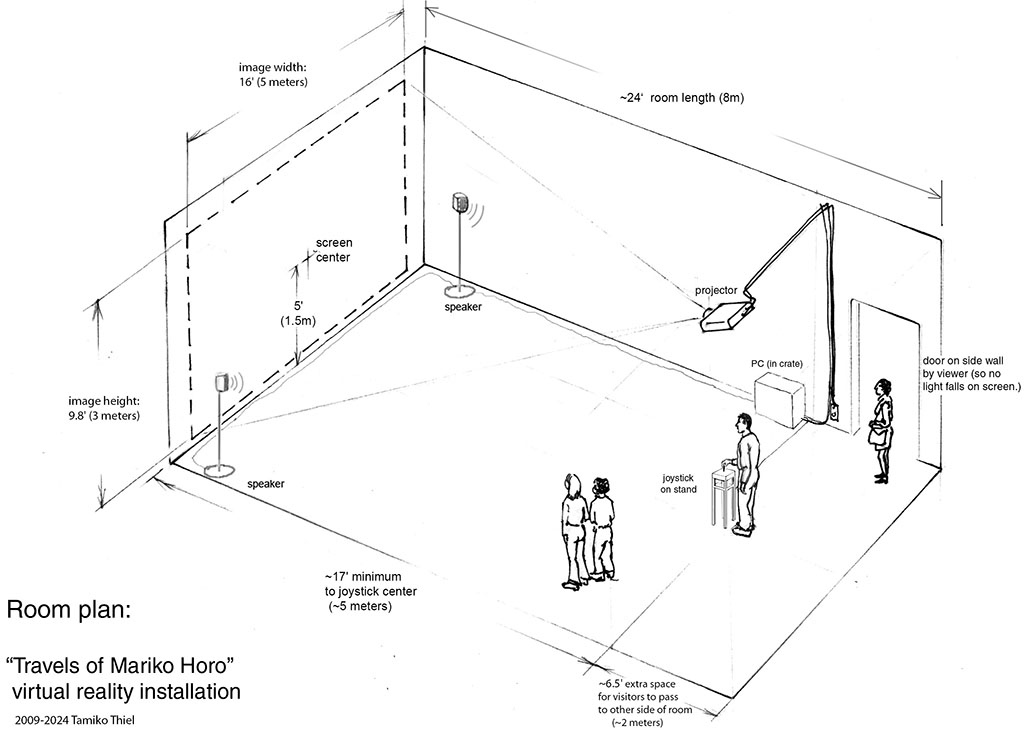
- Click on image for larger web image
- This image also included in the printable installation description
Installation requirements:
Room and Screen:
The room should be dark and FULLY ENCLOSED on all sides and ceiling:
- entrance on the side toward the back, so light does not fall directly
on the screen.
- walls should extend to the ceiling, so that no light leaks in.
- no other sources of sound nearby (sound track has a wide dynamic range,
sometimes very quiet and sometimes very loud).
Room size (minimum):
- 3.5m high x 6m wide x 8m deep (10' high x 17' wide x 24' deep.)
Screen size:
- Screen (for life-sized image): 3m high by 5m wide (~9' by 16')
- Screen center: 1.5m (5') from floor (bottom edge of screen w/in 10cm (4") of floor!)
Hardware and software (to be provided by the venue):
Data projector (takes computer input):
- image resolution 1920 x 1080 pixels
- ceiling mountable (or rear projection)
- keystone distortion compensation
- 4000 ANSI lumens minimum
- specs should indicate it can handle a screen size of 6m diagonal (19' diagonal.)
- long PC-projector cable to reach PC.
PC hardware (MINIMUM requirements):
- Intel i5 processor
- 8 Gigabyte of system RAM
- Mouse and keyboard (for booting system)
- Sound card: ideally M-Audio Delta Audiophile 2496 or equivalent
- Graphics card: NVIDIA GeForce GTX 1050 is good, and cheap
PC software (minimum requirements):
- Windows 10 or 11
Stereo PC speakers:
- Ideally Genelec 1029 APM 2-way active 40 Watt or equivalent (large, active PC stereo speakers capable of handling a large dynamic range).
- Speakers should be mounted to the right and left of screen.
Fixtures:
- Joystick stand (per my drawings): Wooden stand roughly 22.5cm square and 90cm high (8 7/8” x 35.5”), to hold joystick box, legs bolted to floor (or floor board) for stability.
I will provide the following hardware and software:
- VRML code for The Travels of Mariko Horo
- Modified joystick in custom-made joystick box
- Bitmanagement BSContact VRML/X3D browser plugin
- Bitmanagement BSContact license